Why use Vista?
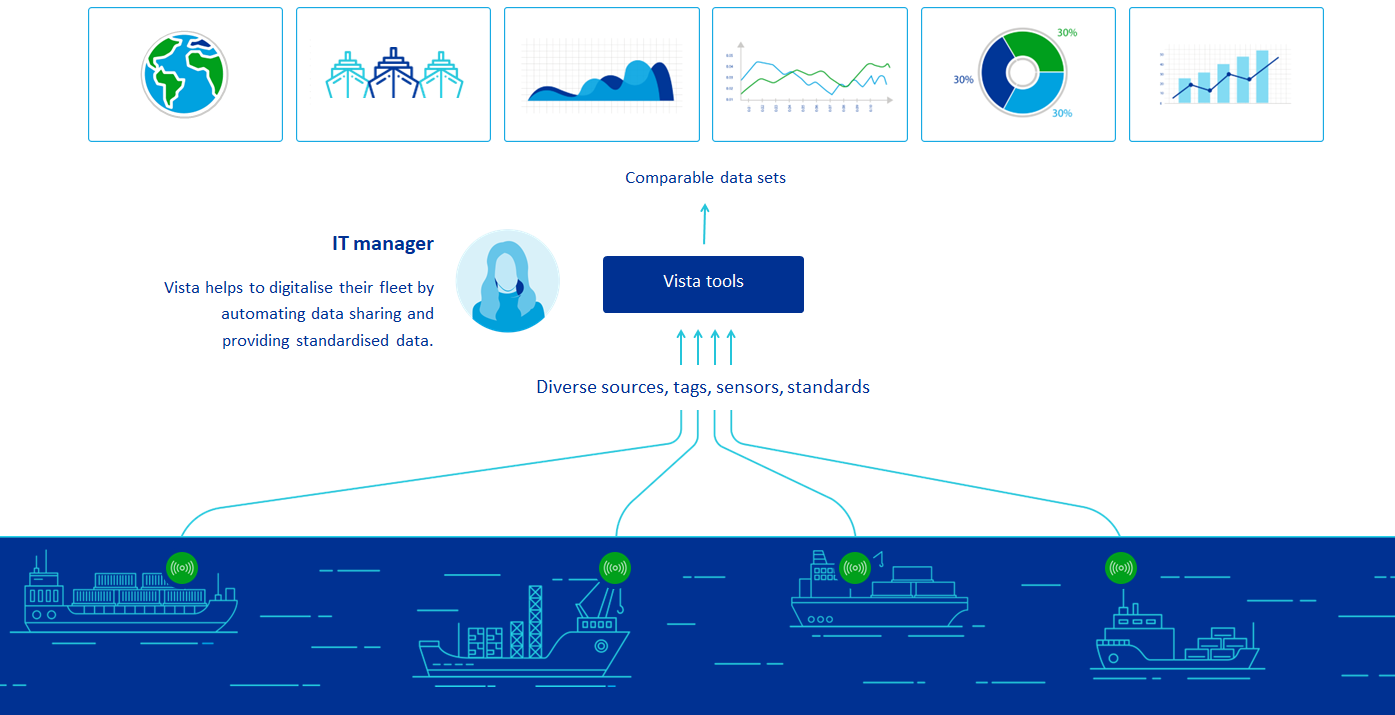
VISTA is a set of tools, documentation and libraries designed to help the industry and DNVs customers to standardize and contextualize sensors and related data in the maritime industry.
VISTA offers a complete set of tools, standards and documentation to enable fleetwide comparable datasets. VISTA focuses on completeness, correctness and flexibility, allowing users to scale the standardization approach to any current and future analytics and reporting problem.
Standardizing sensor names
Sensor data from ships is playing an increasingly important role in ship operations. Many different on-board systems are generating data for automation and decision-support, primarily for dedicated on-board. THe same data is also sent to shore utilizing improved ship-to-shore connectivity. Over the last years, all maritime players have made significant investments in digitalization, however pilots projects have shown that there are still barriers against sharing and efficient use of such sensor data in new applications.
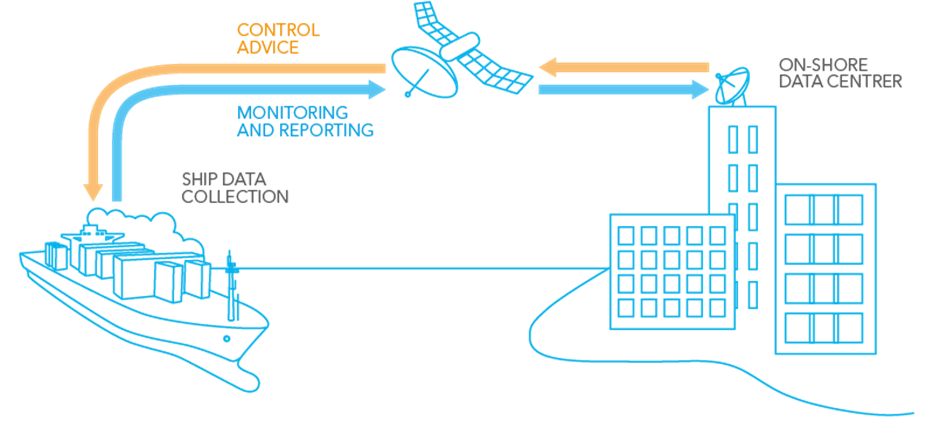
To keep track of metadata and to structure the storage and processing of sensor data, there is a need for a unique identification of sensors as well as the components and systems subject to monitoring by sensors. As no standard naming method was available, legacy implementations have been based on different proprietary, vendor-defined naming schemes, that have proven difficult to interpret and share. Lack of standards have therefore hampered interoperability, sharing and reuse of data. The main purpose of a sensor name (tag) is to provide a unique reference (identifier) to a data channel which can be used in sensor-related tasks such as measurement, configuration, meta data, analysis and processing of the results obtained from the sensor data. The advantage of having a standardized naming scheme is that the sensor name can be interpreted accurately and automatically across a fleet of vessels and from different manufacturers. A standardized approach makes exchange of sensor data between different systems and companies easier and less error prone. In addition to providing uniqueness for referencing, a good naming scheme should also provide additional information and context relevant for the ship, sensor and the monitored component or function. VIS, a rich and mature information model, used in DNV’s classification services since 2005, has been found highly suitable for this purpose. With the new standard sensor naming method “dnv-v2”, based on VIS, DNV has created the fabric of a unified framework and language for exchange of sensor data in the maritime industry.